
Milestone in Early Lung Cancer Detection
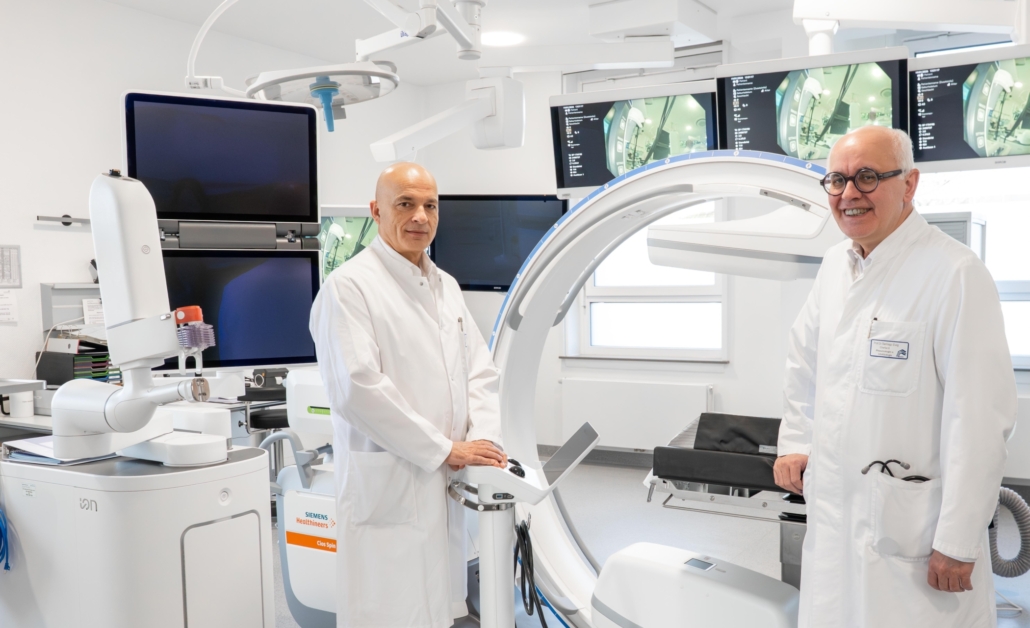
Ion Robot Makes Thoraxzentrum Ruhrgebiet a European Pioneer
It is the latest acquisition at the Thoraxzentrum Ruhrgebiet and a milestone in the early detection of lung cancer: the Ion robotic system. This technology enables robotic-assisted bronchoscopy, allowing even very small nodules that were previously almost unreachable to be targeted precisely for biopsy. As a certified lung cancer center of the German Cancer Society, the Thoraxzentrum Ruhrgebiet is thus optimally positioned for the lung cancer screening of high-risk patients starting in the spring. Furthermore, Ion is now the third robot in use in Herne-Eickel. In no other thoracic surgery department in Europe do patients benefit from such a wide variety of robotic systems for the diagnosis and treatment of lung cancer.
If lung cancer is suspected—for example, because shadows were detected on X-rays—a bronchoscopy is usually performed for further clarification, during which a tissue sample is taken. What sounds simple is often a challenge for physicians, as more than seven out of ten cancerous nodules form in the deep, outer zones of the lungs. These are difficult to reach using conventional bronchoscopic techniques. This is exactly where Ion comes in: based on computed tomography (CT) scans, the robotic system creates a kind of road map of the lung with all its branching airways. Like a navigation system in a car, the surgeon can then guide a catheter to the target based on this map. Subsequently, instruments can be inserted into the catheter, allowing the surgeon to take a sample of the tissue identified as suspicious on the CT. The exact position is verified using a state-of-the-art cone-beam CT scan. This specialized 3D X-ray allows for biopsy with millimeter precision. “The probability of reaching smaller pulmonary nodules with conventional bronchoscopy is 30 percent. With the help of the robotic-assisted system, we achieve values of up to 95 percent. Furthermore, complications occur significantly less frequently,” explains Prof. Dr. Santiago Ewig. The Medical Director of the Department of Pulmonology and Infectious Diseases is pleased to be able to offer a state-of-the-art biopsy that is particularly gentle and, thanks to its accuracy, spares patients from frequent follow-up checks.
In the future, the robotic-assisted system will be used as standard for bronchoscopies at the Thoraxzentrum Ruhrgebiet. Their number—previously more than 3,000 annually—will increase significantly with the start of lung cancer screening. Starting in April 2026, active and former smokers aged 50 to 75 who have smoked heavily for at least 25 years will be entitled to a free CT examination. The Thoraxzentrum has established a cooperation with radiological practices in the Ruhr region and, as a center of excellence with radiologists, pulmonologists, and thoracic surgeons specifically trained for screening, is available for expert assessment to examine, advise, and, if necessary, treat every patient with a suspicious finding.
With screening, changes in lung tissue are detected so early that lung tumors can be treated in their early stages. Despite progress in therapy, lung cancer remains one of the deadliest cancers because it has previously mostly been detected only in very advanced stages.
If the suspicion of lung cancer is confirmed, patients at the Thoraxzentrum Ruhrgebiet benefit from state-of-the-art medical technology during further treatment: in addition to robotic-assisted bronchoscopy with Ion, the DaVinci and HUGO robotic systems are also used in the operating room—a unique selling point in thoracic surgery across Europe. For Dr. Erich Hecker, who leads the Thoraxzentrum as Medical Director of the Department of Thoracic Surgery together with Prof. Dr. Ewig, the advantages of advanced medical technology are obvious: “Even today, our surgical procedures have a complication rate that is far below the requirements of the respective professional societies. By using robotics, we aim for a rate as close to zero as possible.” The physicians can counteract potential fears: “While robotics plays a significant role in patient safety, the surgeon remains the one who performs the corresponding actions. Robotic technology will always only be an assistant and will never work independently,” emphasize Prof. Dr. Ewig and Dr. Hecker in unison.
The Thoraxzentrum Ruhrgebiet is a specialist clinic for thoracic surgery, pulmonology, and thoracic oncology at the Evangelisches Krankenhaus Herne-Eickel, as well as pulmonology at the Augusta-Kliniken Bochum. Both locations are part of EVA Ruhr (Evangelischer Verbund Augusta Ruhr) with seven hospital locations in Bochum, Castrop-Rauxel, Gelsenkirchen, Hattingen, Herne, and Witten.
“With the new robotic system, we are excellently positioned for the diagnosis of lung cancer—not only within EVA Ruhr but also far beyond the region. If the suspicion of cancer is confirmed, patients can also be certain that they will receive further treatment at the highest medical level at our EVA Ruhr Thoraxzentrum Ruhrgebiet, with medical equipment that is unique in Europe,” says Olaf Walter, Group Managing Director and Spokesperson for the Healthcare Sector of EVA Ruhr.
At its two locations in Herne-Eickel and Bochum, the Thoraxzentrum Ruhrgebiet cares for over 14,000 outpatients and 8,500 inpatients every year.
This post is also available in:


